


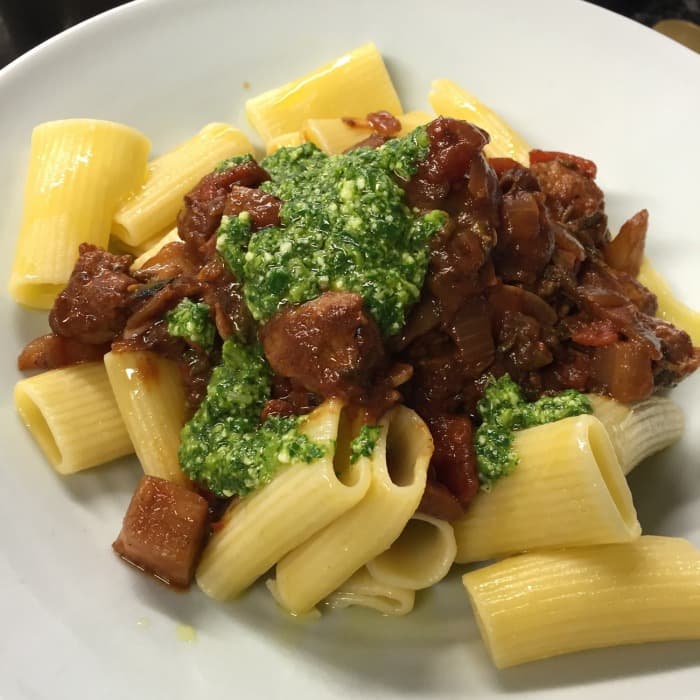
Rigatoni with fennel sausage sauce
Rigatoni with fennel sausage sauce from Italy. Times were inferred from the source steps.
Imported from TheMealDB. Times and card copy were filled in for this listing, not kitchen-tested.
0 people cooked this in the public kitchen yet. Kitchen-tested by I Want Some Food. Not a purchased rating.
- Prep
- 10 min
- Cook
- 1 hr 19 min
- Total
- 1 hr 29 min
- Difficulty
- A bit of work
- Spice
- No chilli
- Cost
- Weeknight budget$8–16 USD · indicative, not a store price
About
Rigatoni with fennel sausage sauce is listed as lamb from Italy. The steps below are the imported TheMealDB method, not an editorial rewrite. Times shown were read from those steps.
Ingredients
- Olive oil2
- Italian Fennel Sausages6
- Onion1
- fennel bulb1
- Paprika2½ ml
- Garlic1 clove
- Fennel Seeds9.9 ml
- Red Wine100 ml
- Tomato400 g
- Sugar2½ ml
- pitted black olives50 g
- rigatoni500 g
- Pecorino Romano30 g
- Anchovy Fillet1
- Garlic1 clove
- Olive oil60 ml
- Basil Leaves50 g
Scaling multiplies the written quantities. Baking still prefers a scale.
Steps
Step 1
Heat a tablespoon of oil in a large saute pan for which you have a lid. Add the sausage pieces and fry on a medium-high heat for 10 minutes, stirring regularly, until golden-brown all over. Transfer the sausages to a plate, then add the onion and fennel to the hot pan and fry for 15 minutes, stirring once in a while, until soft and caramelised; if the pan goes a bit dry, add a teaspoon or so of extra oil. Stir in the paprika, garlic and half the fennel seeds, fry for two minutes more, then pour on the wine and boil for 30 seconds, to reduce by half. Add the tomatoes, sugar, 100ml water, the seared sausage and half a teaspoon of salt, cover and simmer for 30 minutes; remove the lid after 10 minutes, and cook until the sauce is thick and rich. Remove from the heat, stir through the olives and remaining fennel seeds and set aside until you’re ready to serve.
65 minStep 2
Bring a large pot of salted water to a boil, add the pasta and cook for 12-14 minutes (or according to the instructions on the packet), until al dente. Meanwhile, reheat the sauce. Drain the pasta, return it to the pot, stir in a tablespoon of oil, then divide between the bowls.
14 minStep 3
Put all the pesto ingredients except the basil in the small bowl of a food processor. Add a tablespoon of water and blitz to a rough paste. Add the basil, then blitz until just combined (the pesto has a much better texture if the basil is not overblended).
Step 4
Spoon over the ragù and top with a spoonful of pesto. Finish with a sprinkling of chopped fennel fronds, if you have any, and serve at once.
Adapt this recipe
The canonical recipe stays intact. Personal versions are labelled. Serving changes are maths, not AI.
Adaptations · 0 / 15 used. Resets 24 August.
Substitutions
onion → shallot
Shallots are sweeter. Use the same volume, or a little extra onion if that is what you have.
garlic (garlic powder or a pinch of onion) → garlic powder or a pinch of onion
1 clove ≈ ¼ tsp garlic powder. The fresh bite will be missing.
tomato (passata or canned chopped tomatoes) → passata or canned chopped tomatoes
Canned tomatoes are often better than pale fresh ones out of season.
pecorino → parmigiano
Parmigiano is milder and less salty. Use a little more pepper.
Tips
- Times on this listing were inferred from the imported method, not kitchen-tested.
History & culture
Editorial cultural notes have not been written for this imported dish.
Editorial history has not been written for this imported dish.
Inspired by
Provenance: Imported. Initial recipe data sourced from TheMealDB and adapted/reviewed by I Want Some Food. Times on this listing were inferred from the imported method, not kitchen-tested.
Questions about this recipe
Answers taken from this dish's times, amounts, swaps and tips — not a chatbot.
How long does Rigatoni with fennel sausage sauce take?
1 hr 29 min all in — 10 min prep, 1 hr 19 min cook. That is the time on this recipe, not a guess.
How many does it serve?
The recipe is written for 4 servings. Scale the ingredient list on the page if you are cooking for a different number.
How hard is it?
A bit of work.
How spicy is it?
No chilli.
What allergens should I watch?
This recipe is labelled for Milk, Fish. Labels are informational — check the packets in your kitchen. This is not medical advice.
Does it fit a diet?
The published recipe is labelled Gluten-free, Nut-free.
What does it cost to cook?
Weeknight budget — about $8–16 USD, as a grocery budget for this recipe, not a restaurant price.
What equipment do I need?
Frying pan, Saucepan, Stockpot, Blender.
How much salt do I put in?
This recipe does not list a salt amount. We will not invent one.
How much sugar?
½ tsp of Sugar.
What can I use instead?
onion → shallot. Shallots are sweeter. Use the same volume, or a little extra onion if that is what you have. garlic (garlic powder or a pinch of onion) → garlic powder or a pinch of onion. 1 clove ≈ ¼ tsp garlic powder. The fresh bite will be missing. tomato (passata or canned chopped tomatoes) → passata or canned chopped tomatoes. Canned tomatoes are often better than pale fresh ones out of season. pecorino → parmigiano. Parmigiano is milder and less salty. Use a little more pepper.
Any tips from this recipe?
Times on this listing were inferred from the imported method, not kitchen-tested.
Can I prepare this ahead?
Bring a large pot of salted water to a boil, add the pasta and cook for 12-14 minutes (or according to the instructions on the packet), until al dente. Meanwhile, reheat the sauce. Drain the pasta, return it to the pot, stir in a tablespoon of oil, then divide between the bowls.
Can I use an air fryer?
This method is not written for an air fryer. The core technique on the page still applies.