


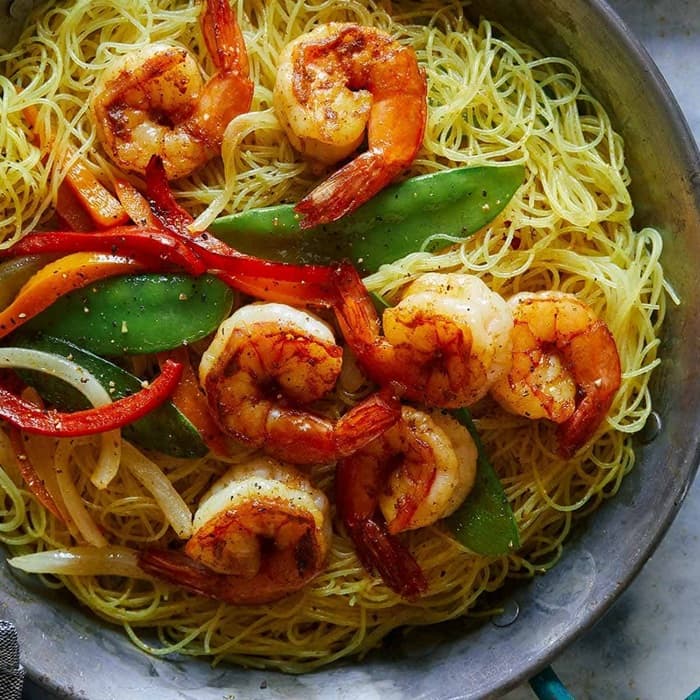
Singapore Noodles with Shrimp
Singapore Noodles with Shrimp from China. Times were inferred from the source steps.
Imported from TheMealDB. Times and card copy were filled in for this listing, not kitchen-tested.
0 people cooked this in the public kitchen yet. Kitchen-tested by I Want Some Food. Not a purchased rating.
- Prep
- 25 min
- Cook
- 9 min
- Total
- 34 min
- Difficulty
- A bit of work
- Spice
- Mild
- Cost
- Weeknight budget$8–16 USD · indicative, not a store price
About
Singapore Noodles with Shrimp is listed as seafood from China. The steps below are the imported TheMealDB method, not an editorial rewrite. Times shown were read from those steps.
Ingredients
- Sesame Seed Oil9.9 ml
- Soy sauce30 ml
- Seasoned Rice Vinegar30 ml
- Vermicelli Rice Noodles170 g
- Egg2
- Ginger2
- Garlic1 clove
- Carrot2
- Fresh chilli1
- Onion½
- Salt2½ ml
- Ham113 g
- Kimchi½
- Spring onion4
- Red Pepper½
- Curry Powder9.9 ml
- Prawn227 g
- Coriander30 ml
Scaling multiplies the written quantities. Baking still prefers a scale.
Steps
Step 1
For the sweet onion, look for Vidalia, OSO Sweet, or Walla Walla. The super-sweet varieties are more suited to this stir-fry because at the end of cooking, the onion still has a slight crunch.
Step 2
Make the sauce: In a bowl, combine the sesame oil, soy sauce, and rice vinegar.
Step 3
Cook the rice noodles: Bring a large saucepan of water to a boil, add the noodles, and use tongs to turn them so they are submerged. Cook for 2 minutes, or until they are tender but still have some bite (they will cook a little more once you add them to the skillet).
2 minStep 4
Drain, rinse with cold water, and use scissors to snip the noodles several times to break them up into shorter lengths.
Step 5
Scramble the eggs: In a small bowl whisk together the eggs. Heat the skillet or Dutch oven over medium heat. Add 1 tablespoon of the peanut or canola oil. Add the eggs and scramble them for 2 minutes, or until they form large, soft curds. Transfer them from the pan to a plate or bowl.
2 minStep 6
Cook the vegetables: Add 1 tablespoon of the remaining oil to the pan. When it is hot, add the ginger, garlic, carrots, jalapeño, onion, and salt. Cook, stirring constantly, for 2 minutes or until the vegetables start to soften.
2 minStep 7
Add the remaining ingredients: Sprinkle the vegetable mixture with the remaining 1 tablespoon peanut or canola oil. When the oil is hot, add the ham, cabbage, scallions, red pepper, and curry powder to the pan. Cook, stirring constantly, for 1 minute.
1 minStep 8
Add the shrimp and cook, stirring, for 3 more minutes or until the shrimp are bright pink and cooked through.
Step 9
Add the noodles in batches: Add the eggs, the sauce mixture, and half the noodles to the pan. Toss for 1 minute.
1 minStep 10
Add the remaining noodles and continue tossing for 1 minute more until they are thoroughly combined and the mixture is heated through.
1 minStep 11
Serve: Taste for seasoning and add more salt or soy sauce, if you like. Sprinkle with cilantro leaves and serve.
Adapt this recipe
The canonical recipe stays intact. Personal versions are labelled. Serving changes are maths, not AI.
Adaptations · 0 / 15 used. Resets 24 August.
Substitutions
egg (silken tofu or skip (depends on the dish)) → silken tofu or skip (depends on the dish)
Carbonara without egg is not carbonara. Fried rice can skip the egg. We will not pretend otherwise.
garlic (garlic powder or a pinch of onion) → garlic powder or a pinch of onion
1 clove ≈ ¼ tsp garlic powder. The fresh bite will be missing.
chilli (paprika or chilli flakes) → paprika or chilli flakes
Paprika is milder and sweeter. Add cayenne if you still want heat.
onion → shallot
Shallots are sweeter. Use the same volume, or a little extra onion if that is what you have.
Tips
- Times on this listing were inferred from the imported method, not kitchen-tested.
History & culture
Editorial cultural notes have not been written for this imported dish.
Editorial history has not been written for this imported dish.
Inspired by
Provenance: Imported. Initial recipe data sourced from TheMealDB and adapted/reviewed by I Want Some Food. Times on this listing were inferred from the imported method, not kitchen-tested.
Questions about this recipe
Answers taken from this dish's times, amounts, swaps and tips — not a chatbot.
How long does Singapore Noodles with Shrimp take?
34 min all in — 25 min prep, 9 min cook. That is the time on this recipe, not a guess.
How many does it serve?
The recipe is written for 4 servings. Scale the ingredient list on the page if you are cooking for a different number.
How hard is it?
A bit of work.
How spicy is it?
Mild.
What allergens should I watch?
This recipe is labelled for Sesame, Soy, Wheat, Eggs, Fish, Shellfish. Labels are informational — check the packets in your kitchen. This is not medical advice.
Does it fit a diet?
The published recipe is labelled Dairy-free, Nut-free.
What does it cost to cook?
Weeknight budget — about $8–16 USD, as a grocery budget for this recipe, not a restaurant price.
What equipment do I need?
Oven, Frying pan, Saucepan, Dutch oven.
How much salt do I put in?
The recipe lists Salt at ½ tsp.
How much soy sauce?
2 tbsp of Soy sauce.
How much kimchi?
½ of Kimchi.
What can I use instead?
egg (silken tofu or skip (depends on the dish)) → silken tofu or skip (depends on the dish). Carbonara without egg is not carbonara. Fried rice can skip the egg. We will not pretend otherwise. garlic (garlic powder or a pinch of onion) → garlic powder or a pinch of onion. 1 clove ≈ ¼ tsp garlic powder. The fresh bite will be missing. chilli (paprika or chilli flakes) → paprika or chilli flakes. Paprika is milder and sweeter. Add cayenne if you still want heat. onion → shallot. Shallots are sweeter. Use the same volume, or a little extra onion if that is what you have.
Any tips from this recipe?
Times on this listing were inferred from the imported method, not kitchen-tested.
Can I use an air fryer?
This method is not written for an air fryer. The core technique on the page still applies.